

Here, the shoreline is quieter, dreamier. The sea doesn’t crash in or drag out. It creeps and ripples with current paths shimmering along the surface. Once a day, it retreats like a woman in meditation, reverently into low tide, a prayer. Here, thin places don’t announce themselves or splash up on shores. They pulse. They hum. They murmur. They shiver a little when you cross through.
Yesterday we sat for a long time watching an osprey circle over the harbor, swooping and rising. Every so often, she’d stiffen her wings, like shoulders drawn up and elbows bent. She’d plummet into a swirling, sharp dive, thump into the water, and come up empty. For a moment, we’d squint and ask one another if she’d caught something. Her flight path would hover over the water, she’d shiver the wet weight off her wings, and soar up up up again. The hunt would restart. We couldn’t look away, straining to peer around trees when she’d drift too far. I’ve yet to see an osprey catch her dinner.
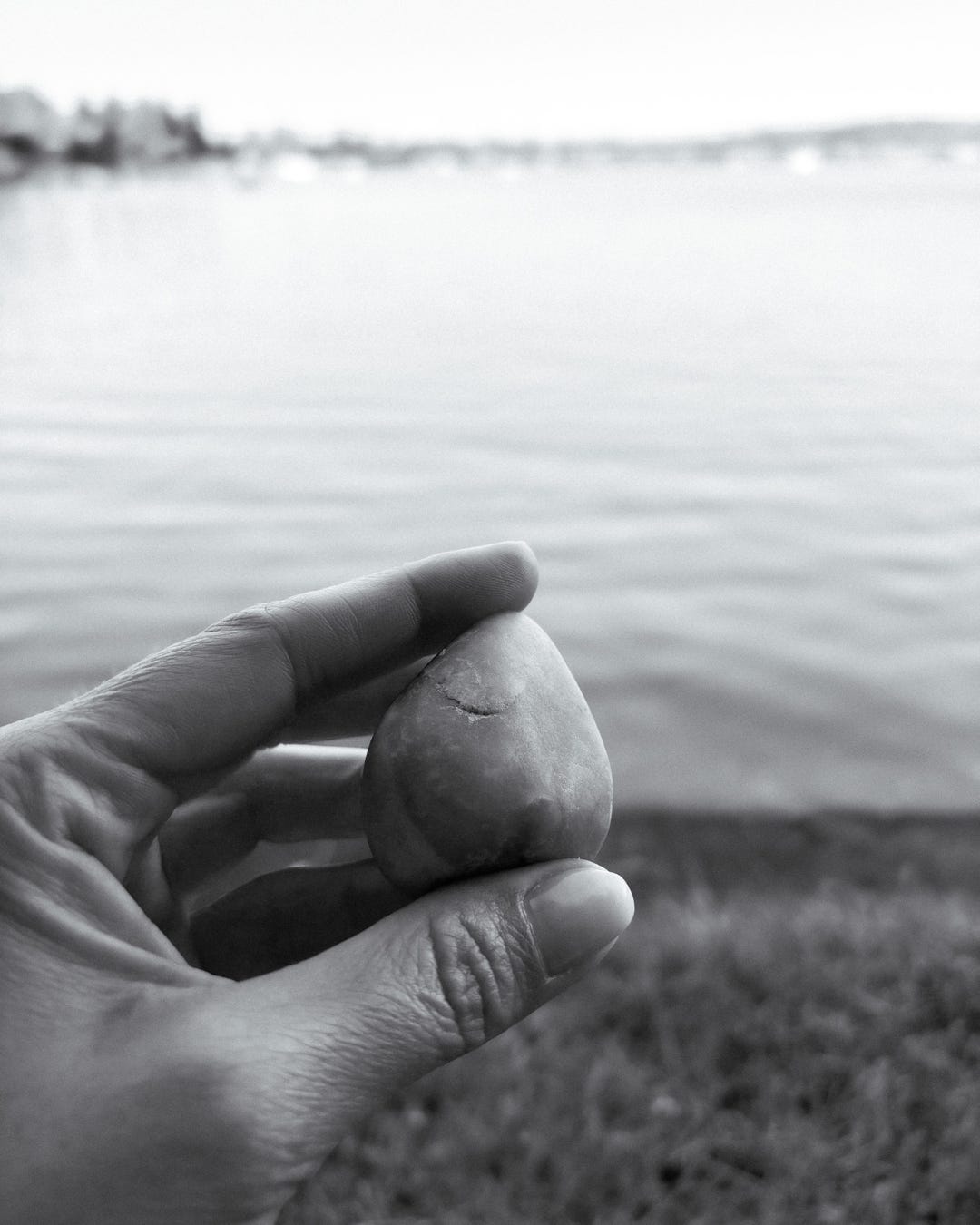
The night before, I took the girls to the shoreline where we perched on large boulders scattered down a stretch of barnacled beach. We held fistfuls of stones, of collected bits of the sea. It’s a Lakota ritual, I’d learned. Hold one piece at a time in your hand, name it for part of your grief. And then give it to the sea. But in the end, the last stone? That one stays with you. It reminds you that your grief travels with you, it is a part of you, there is no version of a life without grief left heavy in your hand. Welcome it. Bring it with you. Give it a home in you. But don’t let it build up like stones in a witch’s pocket. The proof of goodness is not in drowning. Learn to float, girls. Let yourself float.
My friend Mel Gentry Bosna often says to me, “In this life, we do not drown.” I think about her when the tide gently crawls up to my toes. I think about our kids when my hands are empty of all but one stone. I think about the living ark we’ve made of our lives and the insistence that not one of us drowns this time.
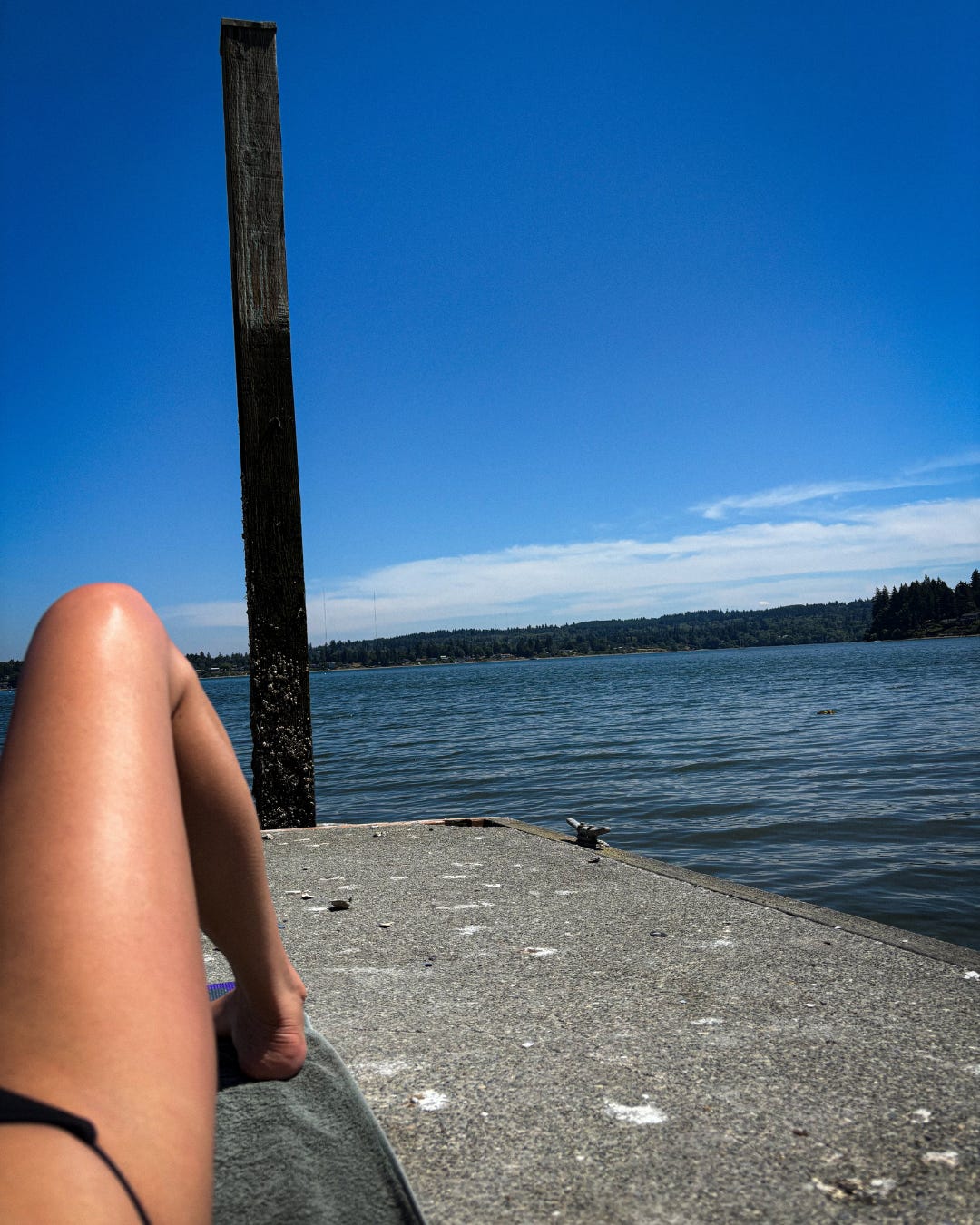
This morning, the coffee is bitter. Reheated in the microwave because I woke up late, and my aunt had already poured her own cup and gone off to work. But I’m cradling it just the same, drinking it slowly and not minding the kickback of a midnight-dark roast that’s sat a little too long. I’m far above the shoreline, still on the deck of the house that perches up on a hill. But I think about lying on the dock in the sun yesterday while the girls paddled around. I’m remembering the pervasive current of anxiety that has mostly dissipated since moving out of the desert, but still emerges sometimes. This is not an easy life, despite what little bits of glow social media shows. It’s still a hard one, but in different ways now.
I had heavy grief to give to the water and a heavy stone to still carry with me. I feel it like a lump in my throat, a boulder I sometimes can’t flow around. But on the dock, I’m watching the expanse of dark green Salish water rippling toward me, the tree line of a peninsula out ahead, and I’m saying to myself, “I am this. This is me.” And I mean the sea, the sucking mud below, the birds hovering over the water like the great mother coming so close our breath mingles. I mean the old trees, the shoreline, the low tide, the sound of the girls singing and talking in the distance. I mean, the fresh mole hills showing up in my aunt’s yard, the hummingbirds drinking from bright red flowers on the deck, the goldfinches gathering around the birdseed, the crows chasing them off. I mean the osprey searching, diving, splashing, and coming up empty, the grapevines growing thick over the perch, the blueberries beginning to fruit in the high garden. I mean the large daisies billowing out of the ground, spilling onto the grass, the geodes and abalone and conch shells spread out over the statue of Jizo - a guide for those in the dark.
I mean that I am this. This is me. And when I let it settle into my body, the boulder of grief in my throat sinks down into my heart, where the greening force of Viriditas covers it with moss and welcomes it as a permanent occupant.
The day we arrived on the island, a UTI hit me with a surprising force. By that night, I was wondering if it had begun crawling its way up into my kidneys. Back pain, slight chills, the beginning of nausea. “Can you Telehealth some meds?” my sister texted. “Girl, this is America.” I wrote back, “I don’t have insurance.” Minutes later, she’d sent me a link to an online company that would do it for $30.
I lay in bed googling things like, “Does a kidney infection ever clear up on its own?” Even with the audacity of the internet, Google kicked back every time, “No. Get medical help.” I did. I’m almost through a round of antibiotics and still taking an extraordinary amount of cranberry, garlic, and uva ursi. But that night I thought about the shorelines of my body, about the loud voice of its love for me. I googled, “What energy do the kidneys hold?”
A vital energy.
Depleted, it can harbor anxiety, a loss of motivation, a deep fear of scarcity.
Fear that you won’t have enough.
Anxiety over basic foundational needs.
Girl, this is America. I don’t have what I need.
I have a web, though, a loving network of family - some by blood and others by sheer love - and they keep me from drowning. There is always just enough not to sink. Sometimes I watch the sea and tides and tree lines of my life, and I think, “I am them. They are me.” Anxiety is less of a boulder, more of a large stone, when I remember we are one another.
In January, my kids’ dad moved out of state, a month after our daughter turned 15 and just days after our middle kid turned 18. He told us less than a month before he left, and the shock or grief or ache for the kids that rippled from that choice first came like a flood. It was hard to discern what was what, all mingled with the debris of past choices that had at times dragged one or all of them out into a riptide. We thought that pattern had ended. No one was expecting a wave to sneak in, rip their feet out from under them. I guess this is why they say to never turn your back on the ocean.
In the in-between space - the time between learning he was leaving and the U-Haul pulling out of Oregon - we just kind of clung to driftwood. The kids’ story - that’s not mine to tell. But I flowed in and out of feelings I struggled to name. Mostly deep grief for them, for everything they’d already navigated and for their resurgent feeling of being set aside for something else. It wasn’t the first time they’d made room for it in their bodies, but it was different this time. The circumstances and reasons were different. They were different.
But I also reached the end of something.
